
Drainage
Gutters, Drainage, and the Damage Cascade on Expansive Soils
Most foundation problems on the Front Range start at the gutter, not at the foundation. The Pierre Shale and Denver Formation soils that underlie most of the metro are highly expansive and respond to changes in moisture content with significant volume change. A gutter that overflows during a single monsoon storm can move enough water into the soil at the foundation to crack a poured wall within a few seasons. This guide covers gutter sizing, downspout sizing, extension distances, and the drainage details that prevent the cascade.
Why expansive soils make Colorado different
Most of the Denver metro sits on Pierre Shale or Denver Formation deposits with swell potential ranging from moderate to highly expansive. When dry, these soils contract and develop deep desiccation cracks. When saturated, they expand vertically by as much as fifteen percent, generating uplift pressures that can crack a foundation wall, lift a slab, or rotate a basement window frame.
The most damaging condition is differential moisture. One side of the foundation receives concentrated water from a downspout, expands, and lifts. The opposite side stays dry and stable. The resulting differential movement produces stair-step cracks in brick veneer, drywall cracks above doorways, and door frames that no longer close.
Gutter sizing for Colorado roofs
The typical Front Range home has a roof area in the range of 1,800 to 3,500 square feet, which generates 1,100 to 2,200 gallons of runoff in a one-inch rain event. Standard 5-inch K-style gutters were sized for smaller mid-twentieth-century homes and routinely overflow on contemporary roof areas.
- 5-inch K-style gutter capacity: roughly 1.2 gallons per minute per foot. Adequate only on roof sections under 600 square feet per downspout.
- 6-inch K-style gutter capacity: roughly 1.8 gallons per minute per foot. The Front Range standard for roofs above 1,800 square feet.
- 7-inch half-round and 8-inch K-style: used on larger roofs, custom homes, and steep pitches that produce concentrated flow at the eave.
- Gutter slope should be 1/4 inch per ten feet toward the downspout, no more, no less. Excessive slope reduces capacity by reducing the effective cross section.
Downspout sizing and placement
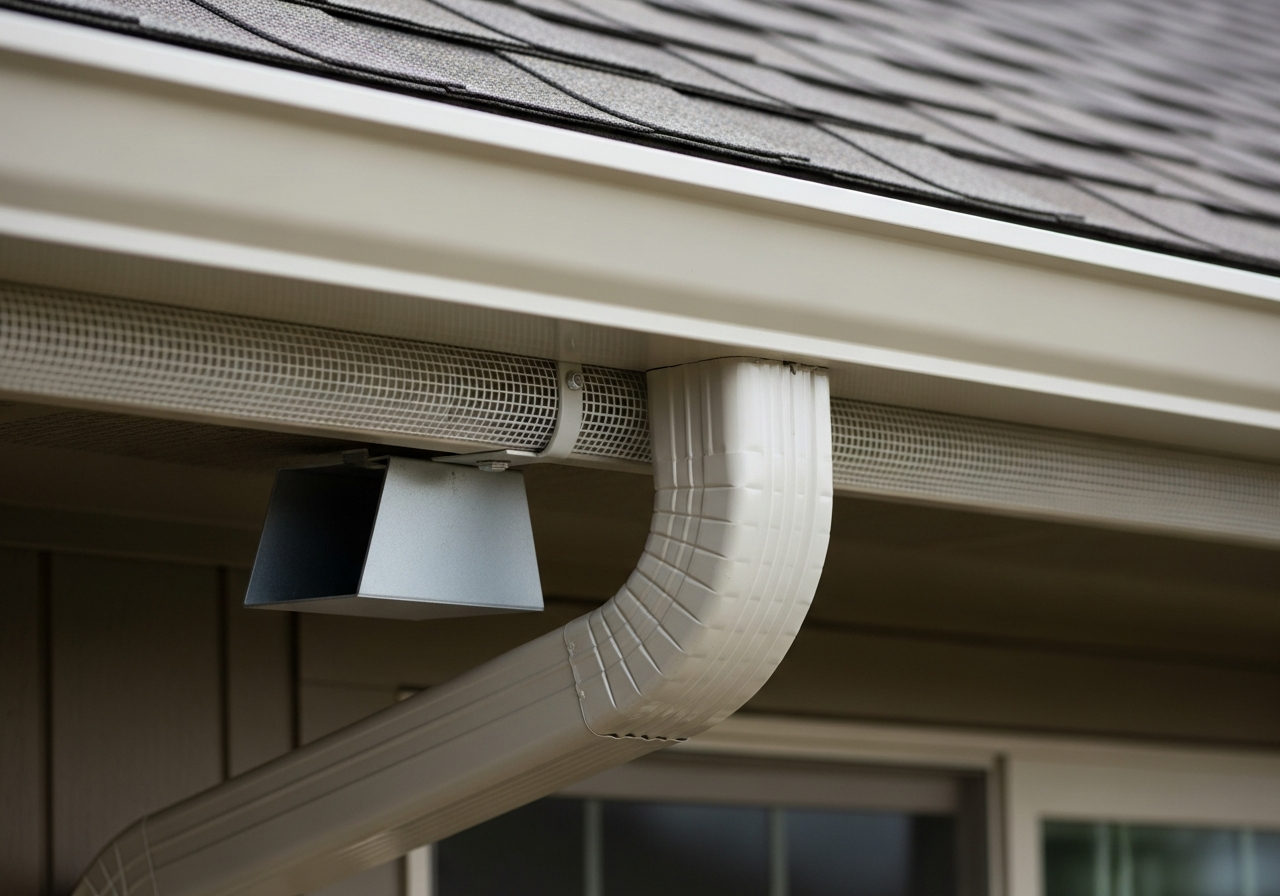
Undersized downspouts are the most common gutter system failure. A 2 by 3 downspout drains roughly six hundred square feet of roof area. Most Colorado roofs need a 3 by 4 downspout for the same coverage, and many need additional downspout count.
- 2 by 3 downspout: 600 square feet of roof per downspout maximum.
- 3 by 4 downspout: 1,200 square feet of roof per downspout maximum.
- Round 4-inch downspout: 1,400 square feet of roof per downspout maximum.
- Locate downspouts at corners and at low points. Avoid running a single downspout for more than forty feet of gutter run.
Extensions, splash blocks, and the ten-foot rule
The standard recommendation across geotechnical engineers in Colorado is to discharge gutter water at least ten feet from the foundation. Splash blocks alone are inadequate. They reduce velocity but do not move water away from expansive soil at the foundation perimeter.
- Aluminum or vinyl downspout extensions to ten feet are the standard solution for above-ground discharge.
- Buried PVC or HDPE drain pipes to a daylight point or to a dry well are the preferred solution where grade allows. Buried pipe must be sloped at least 1/8 inch per foot and must terminate at a visible daylight point or an inspectable cleanout.
- Bentonite clay or compacted clay capping at the foundation perimeter, sloped away from the structure at six inches over the first ten feet, reduces moisture migration into the foundation soils.
- Avoid discharging downspout water into landscape beds at the foundation. Drip irrigation in those beds compounds the saturation problem.
Gutter guards and the cottonwood problem
Front Range trees produce a heavy seasonal debris load that exceeds many gutter guard designs. Cottonwood and elm seed in late spring forms a felt-like mat that blocks both screens and reverse-curve covers. Pine needles in foothill neighborhoods slip through standard mesh.
- Micro-mesh stainless steel guards from Gutterglove, LeafFilter, and Valor handle most Front Range debris when installed at the correct slope. Annual brushing of the top surface is still required.
- Reverse-curve covers shed pine needles well but accept cottonwood seed and elm seed and require disassembly to clean.
- Foam inserts and brush guards are not durable in Colorado UV and are not recommended for permanent installations.
- Even with guards, schedule one inspection per year. Guards reduce cleaning frequency, they do not eliminate it.
Heat cable and ice dam interaction
Heat cable in gutters and at the eave manages ice dam runoff but does not prevent the underlying problem, which is heat loss from the conditioned space into the attic. Self-regulating heat cable from companies including Heat-Line and Pentair is the appropriate product when used. Constant-wattage cable is no longer the standard because it overheats during warm conditions and shortens its own service life.
The correct sequence for ice dam prevention is air sealing the attic floor first, insulation to R-49 minimum second, and ventilation per IRC R806 third. Heat cable is the fourth-line solution, used on problem eaves and over entries where falling ice creates a safety hazard.
Repair cost reference for the cascade
When the gutter and drainage system fails, the downstream costs follow a consistent pattern across the Denver metro.
- Foundation crack repair, hairline interior crack injection: 600 to 1,500 dollars per crack.
- Foundation crack repair, structural exterior excavation and waterproofing: 4,000 to 12,000 dollars per side.
- Slab releveling with polyurethane foam: 1,500 to 4,500 dollars per affected room.
- Drainage retrofit including new 6-inch gutters, 3 by 4 downspouts, and buried extensions: 3,500 to 7,500 dollars on a typical Front Range home.
- Window well replacement after frost heave damage: 800 to 2,000 dollars per well.