
Insurance
Post-Hailstorm Homeowner Checklist for Colorado
After a major Colorado hailstorm, the order of operations matters more than speed. In the first 24 hours focus on personal safety and damage documentation, not contracts. Within seven days get a written independent inspection and notify your insurer. Within 30 days finalize the claim, lock in a Colorado-licensed contractor with an SB 38 compliant written contract, and never let anyone waive your deductible (illegal under CRS 6-22-105).
First 24 hours: safety and documentation
Stay inside until the storm and any secondary cell pass. Severe Colorado hailstorms are frequently followed by a secondary thunderstorm or downburst within 48 to 72 hours.
Once it is safe, walk the perimeter and photograph every elevation from the ground. Capture wide context shots first, then close-ups of dented gutters, downspouts, AC condenser fins, window screens, garage doors, mailboxes, vehicles, patio furniture, and landscaping. Stripped trees and shredded leaves are often the strongest evidence of hail size.
Pull the NOAA storm record for your ZIP code at ncei.noaa.gov/stormevents. Adjusters use the same data; matching the official record strengthens your claim.
Mitigate further damage but do not make permanent repairs. Place buckets under interior leaks, move belongings off wet floors, lay plastic sheeting over broken windows, and arrange professional emergency tarping if shingles are missing or punctured. Keep all receipts; mitigation is a covered expense under almost every policy.
Do not climb the roof. Use binoculars or a phone zoom from the ground or a ladder peek over the edge. Roofs after hail are slick and granule-strewn, and 15 to 20 percent of insurance claims are reduced or denied because the homeowner failed to mitigate properly. Falling off your own roof while taking pictures qualifies.
- Stay inside until the storm and any secondary cell pass
- Check for downed power lines, gas smells, structural sag
- Shut off power to wet circuits at the breaker
- Walk the perimeter and photograph all four elevations
- Photograph dented gutters, AC fins, screens, vehicles, garage doors, mailbox, patio furniture
- Photograph interior leaks, ceiling stains, and attic with flashlight
- Place buckets, move belongings, lay plastic over broken openings
- Order professional emergency tarping if shingles are missing or punctured ($300 to $1,500 typical)
- Pull the NOAA storm report for your ZIP code and save it
- Start a written claim journal
- Do not climb the roof or sign any contractor paperwork
First 7 days: independent inspection, declarations review, and claim notice
After the home is stable, build the evidence file before you file, when you can. A reputable Colorado-based roofer will perform a free inspection, do a 10 by 10 foot test square on each slope, mark hail hits with chalk in a contrasting color (typically circling 8 to 12 hits per slope), and produce a written report with photos. This catches subtle bruising (cracked fiberglass mat under the granules) that ground-level adjusters frequently miss and identifies collateral damage to siding, gutters, vents, AC condensers, and skylights.
Before you file, weigh the trade-off. A claim that does not result in payout still appears on your CLUE report (Comprehensive Loss Underwriting Exchange) for 5 to 7 years and can lead to premium increases of 7 to 10 percent or non-renewal in today's tightening Colorado market.
Read your declarations page for: separate wind and hail deductible (flat or percentage), cosmetic-damage exclusion, matching exclusion, ACV versus RCV roof coverage, and roof-age depreciation schedules. These four items determine 90 percent of what you actually receive.
When you file, get a claim number in writing and ask in writing for the prompt-notice deadline, the claim filing deadline, the supplement deadline, and whether you have a separate wind and hail deductible. Major Colorado carriers include State Farm, USAA, Allstate, Farmers, American Family, Nationwide, Auto-Owners, Travelers, and Liberty Mutual, plus the Colorado FAIR Plan as a last resort.
Do not sign anything other than your insurer's claim forms. No Assignment of Benefits, no contingency contract granting exclusive rights to the work, no blank contracts, and nothing that lets a contractor negotiate with your insurer (that crosses into public adjusting, which Colorado prohibits roofers from doing).
First 30 days: adjuster, contractor, and repair plan
Be present for the adjuster's inspection. Have your independent roofer there too if possible. Walk the adjuster through every chalk-circled hit, gutter dent, and interior stain. Provide your photo file and the NOAA report.
Review the adjuster's scope of loss line by line and compare it to your contractor's estimate (usually written in Xactimate). Common items insurers under-scope or omit: starter strips, ridge and hip caps, drip edge, ice and water shield (Colorado code requires it in most jurisdictions), proper decking thickness, code-required upgrades, and detach and reset of solar or satellite equipment.
File a supplement if your contractor finds additional damage (rotted decking, hidden flashing failure, siding hail bruising). Supplements recover $3,000 to $15,000 on a typical Colorado residential hail claim and are completely normal.
Sign an SB 38 compliant written contract with all required clauses (scope, materials, total price, contractor identity and insurance, 72-hour rescission, the second 72-hour rescission triggered by an insurer revision, the trust-account deposit requirement, and the explicit prohibition on the contractor paying or waiving the deductible).
Coordinate with your mortgage company. Insurance checks for dwelling damage are nearly always made payable jointly to you and your lender. Call the lender's Loss Draft department immediately. For claims under approximately $10,000 to $40,000 (the threshold varies; Mr. Cooper's is $40,000) the lender often endorses the check back to you. Larger claims are placed in escrow and disbursed in three stages: roughly one-third up front, one-third after a 50 percent inspection, and one-third after final inspection.
Pay your deductible, and only your deductible, out of pocket. Anyone who tells you they can make it disappear is asking you to commit insurance fraud under CRS 18-5-211 (a class 5 or 6 felony that also voids your claim).
Confirm permits are pulled before tear-off begins. Every Colorado municipality requires a roofing permit and many require a mid-roof and final inspection. Permit fees and code-required upgrades are recoverable from the carrier.
Photo method that adjusters respect
Adjusters look for a pattern of distributed hail impacts that match a documented storm of the right size. Replicate the inspection method professionals use.
- Phone camera at 1x zoom (not 0.5x, which distorts), HDR on, date stamps enabled
- Every elevation of the home from across the street
- Each roof slope: four corners (lower-left, lower-right, upper-left, upper-right) plus a 10 by 10 foot test square
- Close-ups with a U.S. quarter or tape measure beside the impact for scale
- Chalk-circle each hit with contrasting chalk (white on dark shingles, dark on light); chalk only what you photograph
- Soft-metal tells: dented gutters, downspouts, gooseneck vents, ridge caps, AC condenser fins, mailbox, gas-meter cover
- Interior: ceiling stains, attic decking with daylight visible, wet insulation, active drips
- Collateral: window screens, skylights, siding (vinyl stress lines, stucco chips, fiber cement cracks), fence panels, deck boards, garage doors, exterior paint chips, outdoor furniture, sod, broken trees
Insurance math every Coloradan should run
If your dwelling Coverage A is $500,000 and you carry a 2 percent wind and hail deductible, you pay the first $10,000 before the insurer pays anything. If your roof replacement scope is $20,000, the insurer issues $10,000 (less any roof-age depreciation if your policy is ACV rather than RCV).
On RCV policies you collect ACV up front and recoverable depreciation once the work is documented and complete. On ACV-only policies (or policies with a Roof Payment Schedule that prorates by age) you may collect 30 to 60 percent of replacement cost on a 15-year-old roof.
A Class 4 roof on a $4,000 annual premium often saves roughly $1,000 to $1,400 per year through a 25 to 28 percent dwelling discount typical on the Front Range, more than offsetting the $1,000 to $3,000 upgrade cost in the first 2 to 4 years. Wind and hail deductible buy-down policies (parametric coverage from carriers like Sola, triggered by NOAA-verified hail size) are an emerging Colorado option for high-deductible policies.
Real estate situations after a storm
If a storm hits before listing, file the claim, install a new roof, and use it as a marketing point (new Class 4 roof, transferable warranty). Update the SPD-19 disclosure to reflect the casualty event. Keep all permits, inspections, and warranty paperwork to transfer at closing.
If a storm hits while under contract, paragraph 19 of the Colorado Contract to Buy and Sell allocates risk to the seller. The buyer's options are: terminate and recover earnest money, allow up to 15 additional days to repair, or close and accept the insurance proceeds plus an amount equal to the seller's deductible.
Buyers in a recent hail belt should request the seller's CLUE report from LexisNexis (only the homeowner can pull it; consumer.risk.lexisnexis.com or 1-866-312-8076), ask for the date of the last roof replacement and any active warranties, order an independent roof inspection in addition to the general inspection, and cross-reference the property against NOAA hail history. A roof that survived the May 2024 storm without a claim may have hidden bruising that surfaces in two or three years, after the claim window for that storm has closed.
Realtors and sellers must disclose adverse material facts under CRS 12-10-404(3)(a) and the Gattis line of cases, expressly including hail or wind damage. I did not know is not a defense if the storm hit while the listing was active.
Storm chaser red flags after a hail event
A short list of patterns that should end the conversation immediately.
- Door-to-door solicitation right after a storm
- Out-of-state license plates or vague we are working in the area pitch
- Promise to waive, pay, or absorb your deductible
- Sign here so we can inspect (often a contingency contract or AOB)
- Demands full payment up front
- No written contract, or contract missing scope, materials, or rescission language
- Offers to act as your public adjuster or negotiate with your insurer
- No physical Colorado office or Colorado business license
- Pressure to act today or limited-time pricing
- No general liability or workers compensation certificate
- Cannot provide GAF, Owens Corning, or CertainTeed certification verifiable on the manufacturer website
- Asks you to sign a blank contract or insurance-proceeds-only contract
From cosmetic to total loss
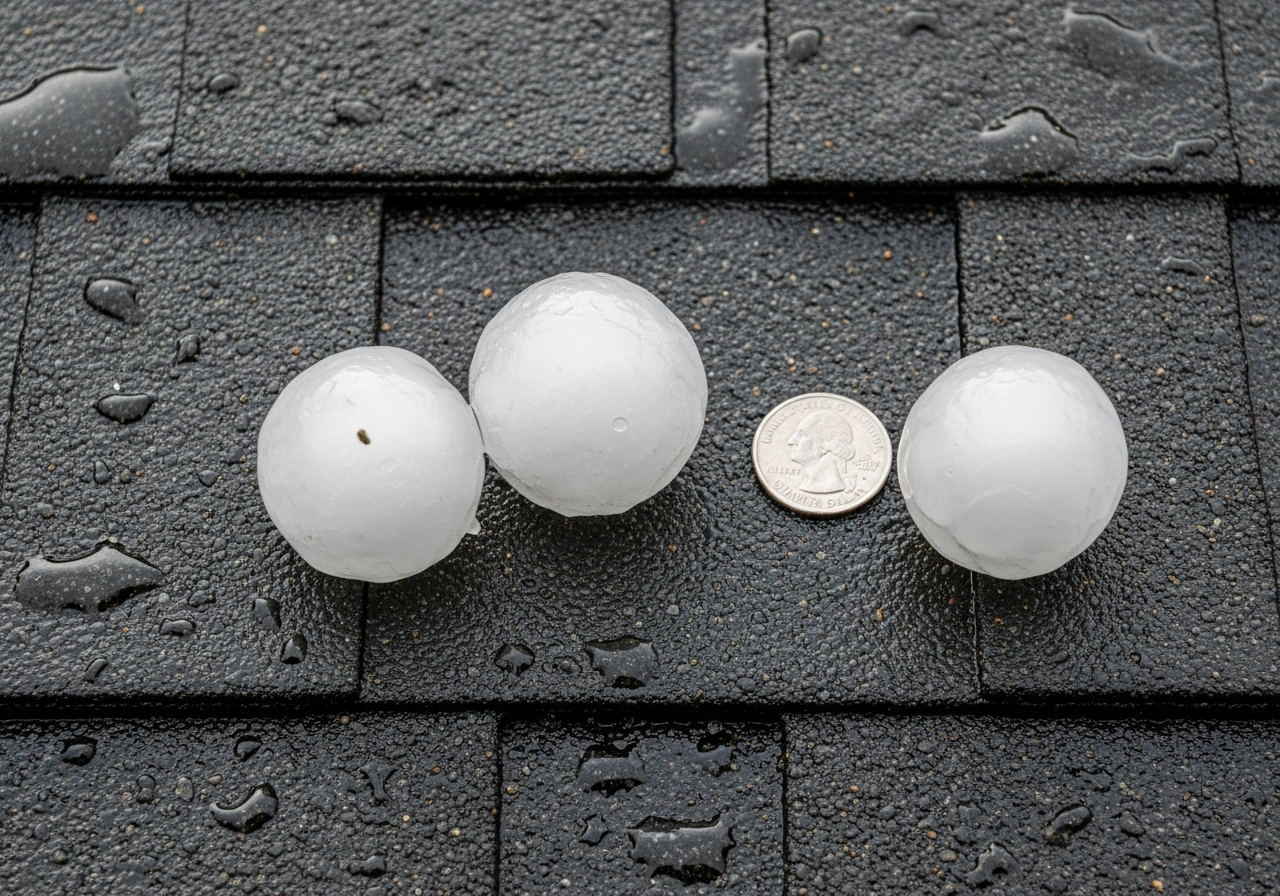
NOAA classifies any hail one inch or greater (quarter-size) as severe. The threshold for a successful asphalt shingle insurance claim varies by carrier and roof age, but most claims are filed in the 1.0 to 1.75 inch range.
- Cosmetic
- Borderline
- Functional
- Total loss
Damage thresholds vary with shingle age, slope, exposure, and impact angle. Pro Shield walks the roof to confirm functional damage before recommending a claim.