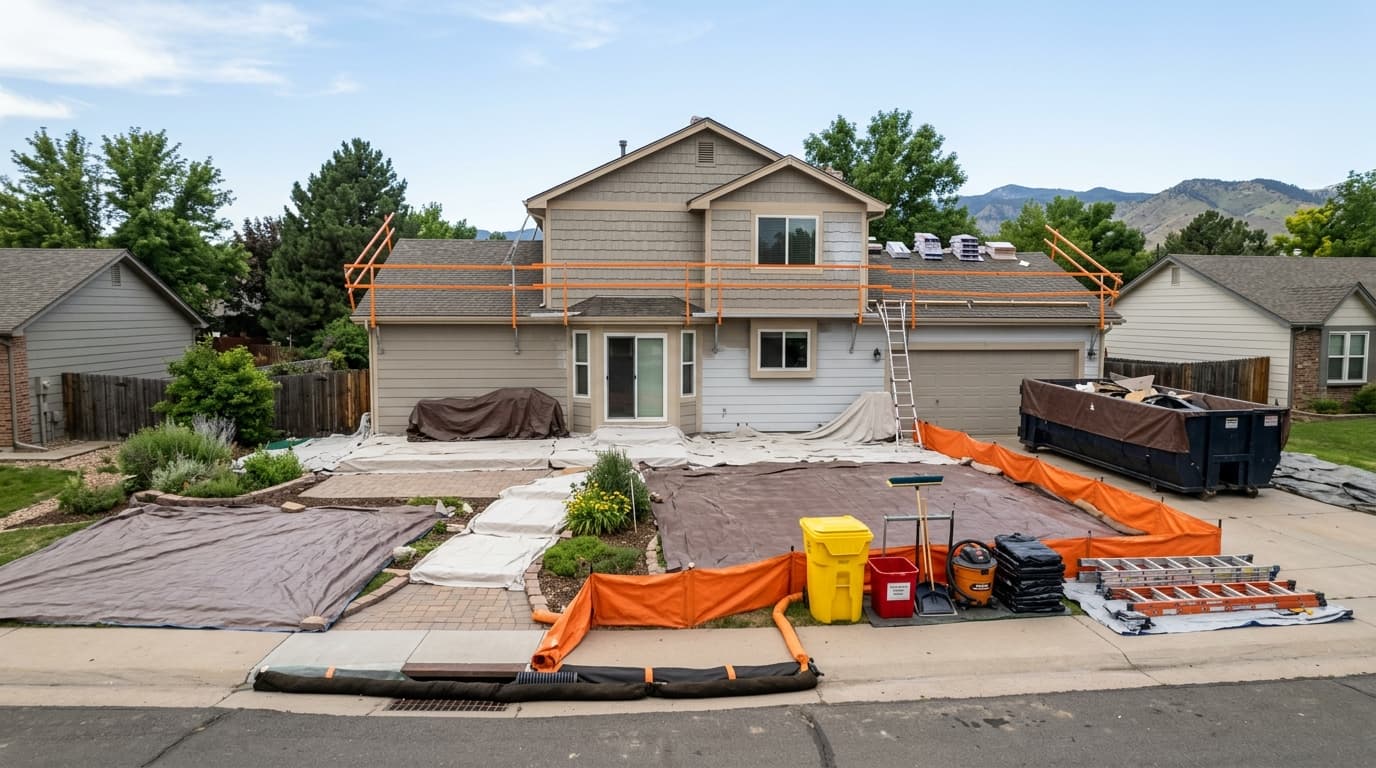
Site protection and daily cleanup are the physical and procedural controls that keep a roofing or painting project from harming your property, your household, or the storm drains around your home. On a Colorado job, four regulated systems govern that work. OSHA housekeeping rules require debris to be cleared as work progresses on every site. The EPA's Renovation, Repair and Painting Rule adds lead-safe containment on homes built before 1978 when paint is disturbed above a small threshold. The EPA's Construction General Permit and stormwater plans control off-site discharge on larger disturbed sites. And hazardous paint or solvent waste has to be segregated rather than tossed in the trash. Pro Shield Roofing & Painting, a Lakewood-based contractor, plans each of these into the scope before crews arrive. Knowing how the four systems fit together helps you judge whether a bid actually includes real protection or just quietly leaves it out.
Which four concerns are often grouped into one bid line item?
Site protection is the set of barriers and coverings that isolate the work zone and catch falling or airborne material; daily cleanup is the removal and correct disposal of that material as the job proceeds. Together they cover four distinct concerns that often get lumped into one line item on a bid.
The first is baseline housekeeping, which applies to every job regardless of building age. The second is lead-safe containment, which only applies when paint is disturbed on a pre-1978 home. The third is stormwater and off-site discharge control, which matters most on larger disturbed sites. The fourth is the correct handling of paint, stain, and solvent waste at the end of each day and at the close of the project.
These are not interchangeable. Roofing debris control and lead-dust isolation are different engineering tasks with different tools. A crew that handles one well may still skip another, which is why it helps to understand each on its own before signing a contract. You can see how we sequence these steps in our project process.
What are the four regulated decision points on a roofing or painting site?
A controlled project is built on four regulated decision points, each with its own trigger and its own failure mode. Recognizing which ones apply to your home tells you what protection the job legitimately requires.
Baseline housekeeping applies to every construction, alteration, or repair site. Under OSHA 1926.25, scrap lumber with protruding nails and all other debris must be kept cleared from work areas, passageways, and stairs. The failure mode is trip, slip, and puncture injuries, plus serious-classified citations.
Debris drop and overhead protection applies whenever tear-off material moves between levels. OSHA sets a specific barricade geometry for that situation, described below.
Lead-safe containment applies when work disturbs paint above a de minimis threshold in housing or a child-occupied facility built before 1978. The failure mode here is the most expensive: per-day, per-violation civil penalties, with a missing record counting as a separate violation.
Stormwater and off-site discharge control applies on sites that disturb one acre or more, or smaller sites that are part of a larger common plan of development, under the EPA Construction General Permit. Most single-family jobs fall below that threshold, but good housekeeping still keeps debris out of gutters and storm drains.
| Decision point | What triggers it | Main risk if skipped |
|---|---|---|
| Baseline housekeeping | Any construction, alteration, or repair | Injuries and OSHA citations |
| Lead-safe containment | Pre-1978 paint disturbed above threshold | Per-day EPA penalties |
| Stormwater control | Disturbing one acre or more | Off-site discharge violations |
How do OSHA housekeeping rules shape debris clearance and tear-off safety?
OSHA housekeeping rules require that debris be removed continuously rather than at the very end of a job. OSHA 1926.25 states that during construction, alteration, or repairs, form and scrap lumber with protruding nails and all other debris shall be kept cleared from work areas, passageways, and stairs in and around buildings. Combustible scrap and debris must be removed at regular intervals during the course of construction, and safe means must be provided to facilitate that removal.
The standard uses the phrases "as work progresses" and "at regular intervals" rather than a fixed daily cadence. There is no federal rule that names a mandatory once-per-day cleanup. In practice, a well-run residential job clears nails, wrappers, and tear-off scrap continuously so the yard and roof stay walkable, and a full magnetic sweep for stray fasteners is standard at close-out on a roofing project.
For tear-off and multi-level work, OSHA 1926.252 adds a barricade requirement. When debris is dropped through holes in the floor or roof deck without a chute, the area onto which the material lands must be completely enclosed with barricades not less than 42 inches high and not less than 6 feet back from the projected edge of the opening above. Warning signs are required, and removal from the lower area is not permitted while debris handling continues above. The same standard requires that all scrap lumber, waste material, and rubbish be removed from the immediate work area as the work progresses.
One Colorado-specific note: OSHA ties disposal by burning to local fire regulations. Along the Front Range, open burning of construction debris is rarely an option, so debris is hauled to a permitted facility instead. On a roof replacement, that usually means a dumpster staged with ground protection beneath it.
When does lead-safe containment under the EPA RRP rule apply to a pre-1978 home?
Lead-safe containment applies whenever a paid contractor disturbs painted surfaces above a small threshold in a home, childcare facility, or preschool built before 1978. The EPA's Renovation, Repair and Painting Rule requires that the firm be certified and its workers trained in lead-safe work practices, as described in the EPA Lead RRP Program.
The trigger is a threshold, not a judgment call. Interior work becomes subject to the rule at six square feet or more of disturbed surface, exterior work at 20 square feet or more, and any window replacement is covered regardless of size. A small touch-up below those limits may be RRP-exempt, but it is never OSHA-exempt. If a component has been tested and confirmed lead-free, the RRP path does not apply even on an older home.
The EPA RRP Work Practices define what containment looks like. Interior work requires covering floors and furniture with plastic sheeting, sealing doorways and HVAC vents, and posting warning signs. Exterior work requires extending ground plastic at least 10 feet from the building to catch falling debris. The rule prohibits certain practices outright, including open-flame burning and the use of power tools without HEPA exhaust control.
Cleanup on an RRP job carries a documented pass or fail step that ordinary housekeeping does not. Crews use a HEPA vacuum, which the EPA RRP frequent questions define under 40 CFR 745.83 as a vacuum with a HEPA filter as the last filtration stage, capable of capturing particulates of 0.3 microns with 99.97 percent efficiency. After wet cleaning, the certified renovator performs a cleaning verification, wiping the cleaned area with a white cloth and comparing it against a reference card. RRP records must be retained for three years per job.
A frequent point of confusion for Colorado homeowners with attached garages: the interior floor of a garage is generally treated as interior space for post-renovation RRP cleanup. That distinction changes how the space is sealed and verified. Many homes in older parts of Denver, Wheat Ridge, and Edgewater predate 1978, so this rule reaches a real share of local exterior repaints. Our exterior painting scopes account for it when the home's age calls for it.
How do paint, solvent, and stormwater waste get handled at end of day?
Paint and solvent waste get segregated by type at the end of each day because much of it cannot legally go in household trash. Paint disposal guidance classifies oil-based, lead-based, and solvent-based paints, stains, and varnishes as hazardous waste that should not go in household trash. Aerosol paints are handled as universal waste and can be taken to a transfer station or household hazardous waste collection point. Latex, or water-based paint, follows a different path and is far less restricted, which is one reason crews keep waste streams separate rather than combining them in one bucket.
Stormwater control is the second end-of-day concern. On larger disturbed sites, the EPA Construction General Permit governs discharge, and site-specific stormwater pollution prevention plans set good-housekeeping practices meant to prevent solid materials from reaching waters. Those practices address trash disposal, sanitary waste, recycling, and proper material handling. The permit deliberately allows flexibility so controls can match the specifics of a site.
Most single-family roofing and painting jobs in Lakewood, Arvada, and Littleton disturb well under an acre and fall outside the CGP. Even so, the same underlying goal applies at the residential scale: paint chips, wash water, and tear-off scrap stay out of gutters and storm drains that feed Front Range creeks. Keeping wash water away from the driveway edge and containing rinse from brushes and rollers is a small step that reflects the same principle. You can read more about how we stage surfaces before painting in our exterior paint prep guide for Colorado.
Frequently Asked Questions
Does the EPA lead-safe rule apply to my home if it was built before 1978?
Yes. Lead-safe containment applies when a paid contractor disturbs painted surfaces above a small threshold in a home, childcare facility, or preschool built before 1978. The EPA Lead RRP Program requires a certified firm and workers trained in lead-safe work practices.
What happens to leftover paint, stain, and solvent after the job?
At the end of each workday, paint and solvent waste is separated by type. Oil-based, lead-based, and solvent-based paints, stains, and varnishes are hazardous waste and should not be placed in household trash.
What protection is required when tear-off debris is dropped from the roof?
When debris is dropped through a floor or roof opening without a chute, OSHA 1926.252 requires the landing area to be fully enclosed by barricades at least 42 inches high and 6 feet back from the opening's projected edge. Warning signs are also required while debris handling continues above.