
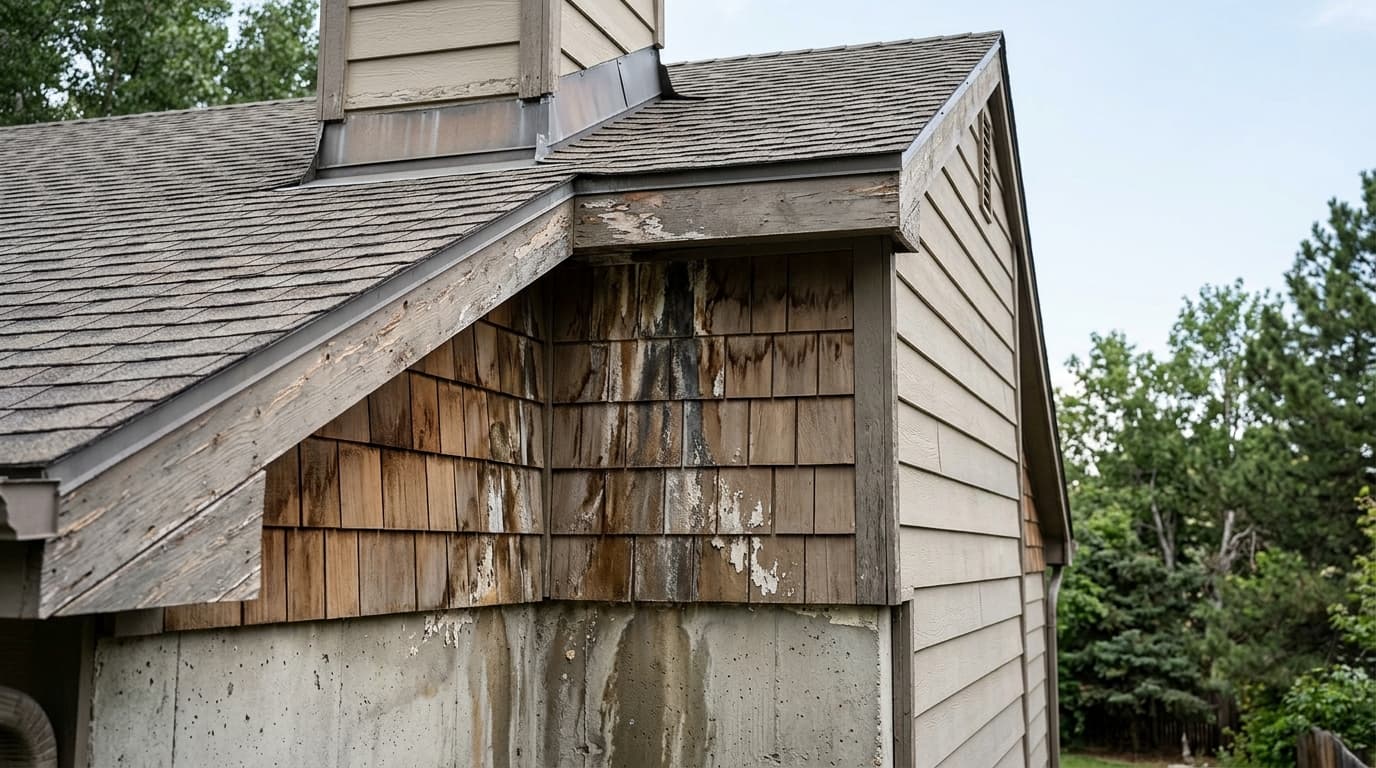
Water intrusion is the unintended penetration of water into a structure through leaks, cracks, or failed drainage, and moisture evidence is the visible or instrument-detectable trail it leaves behind: staining, warping, odor, or elevated moisture readings. The most useful thing to understand is that the evidence you can see is almost never where the water actually entered. Water migrates through hidden pathways before it surfaces, so the stain on your ceiling may sit several feet from the failed flashing that caused it. That gap between symptom and source is why reading the evidence correctly matters more than reacting to how bad it looks. A small stain can mean a large hidden problem, and a dried patch can hide active decay. At Pro Shield Roofing & Painting in Lakewood, we treat moisture evidence as a starting point for diagnosis, not a conclusion, because misreading the source is what turns one repair into three.
What Do Water Intrusion and Moisture Evidence Actually Mean?
Water intrusion is water entering a building past the point where the assembly was designed to stop it. Per the ASTM E2128 guide for evaluating water leakage of building walls, penetration counts as leakage when it exceeds the wall's planned resistance or its temporary drainage and retention capacity, is likely to cause premature deterioration, or degrades the performance of other building components. In plain terms, a little water that drains and dries as designed is not a failure; water that lingers, damages, or spreads is.
The building envelope is the barrier separating your interior from the weather, and it includes the roof, walls, windows, and doors. When any part of that barrier fails, water finds a way in. Moisture evidence is the set of clues that failure leaves behind. Some of it is obvious, such as ceiling stains, peeling paint, and a musty smell. Some of it is only detectable with instruments, such as elevated moisture content inside framing that still looks dry on the surface.
The practical takeaway for Denver metro homeowners is that "moisture evidence" is a category of symptom, not a single problem. A brown ring on drywall, a warped baseboard, and a soft roof deck are all evidence, but they can point to entirely different sources and demand entirely different repairs.
How Do You Read Moisture Evidence as a Map, Not a Diagnosis?
Read visible moisture evidence as a map that points toward a source, not as the source itself. Water rarely travels in a straight line. It can run along the top of insulation, down a stud cavity, or across a horizontal framing member before it emerges through a finish surface. The result is that damage frequently surfaces well away from the entry point, and repairs aimed at the stain instead of the source tend to fail again.
The most common way this goes wrong is a misattributed source. Water can enter through roofs, walls, windows, plumbing, or HVAC systems, and each requires a different fix. HVAC condensation in particular can mimic a roof or wall leak, which complicates diagnosis on homes across Arvada, Wheat Ridge, and Littleton where forced-air systems run hard through summer.
The second failure mode is delay. Small leaks that go unaddressed become larger problems, because water sitting behind walls or above ceilings damages structural components, feeds mold, and degrades insulation. A useful root-cause frame comes from Building Science Corporation's rain control digest, which reduces the whole problem to three functions: deflection, drainage, and drying. When you can name which of those three failed, you know whether the symptom traces to bad flashing and overhangs, blocked drainage, or an assembly that cannot dry out. That framing is also why the approach to a roof inspection starts at the likely source rather than the visible stain.
Cosmetic Surface Mold or Structural Decay: Which Problem Do You Have?
Surface mold is usually cleanable; structural decay is not. That distinction is the fork that decides your entire project scope. Surface mold is a cosmetic issue you can often clean and correct by removing the moisture source. Structural decay fungi are a different organism that consumes wood fiber, and the damage they cause is irreversible. The affected member has to be repaired or replaced.
The threshold that separates the two is moisture content, abbreviated MC, which measures how much water is held inside the wood. Structural decay requires sustained moisture content above 28 percent MC, the fiber saturation point, to initiate. Below that, wood may grow surface mold or stain, but decay fungi cannot get established. Above it, and held there long enough, the wood is at genuine structural risk.
Here is the trap that catches homeowners and even some inspectors. A moisture reading taken today only tells you today's condition. A framing member that was saturated well above 28 percent, then partially dried back to 22 percent, can still harbor active decay that a single moisture reading will not reveal. This is why a dry-ish number is not the same as an all-clear. Whenever wood has spent significant time above 28 percent MC, a structural assessment is warranted regardless of the current reading. On older Lakewood and Golden homes with layered roof histories, we treat any framing with a known soaking event as a candidate for inspection even after it dries.
How Long Do You Have Before Moisture Becomes Mold?
You generally have 24 to 48 hours. If wet or damp materials are dried within 24 to 48 hours after a leak or spill, in most cases mold will not grow, according to the EPA's Brief Guide to Mold, Moisture and Your Home. The EPA's Mold Course Chapter 9 states the same target as an operating rule: all wet areas should be completely dried within 48 hours to prevent mold from growing.
That window is why response time matters more than almost anything else after a leak. The governing principle from the EPA is direct: the best way to control mold growth is to control moisture. If you find water, the clock starts, and getting the affected materials dry inside two days is the single highest-value action you can take.
Humidity is the parallel lever that operates every day, not just after a leak. The EPA recommends keeping indoor relative humidity below 60 percent, and ideally between 30 and 50 percent. During Colorado's summer monsoon stretch, indoor humidity can climb after wind-driven rain, so pairing prompt drying with humidity control gives mold the least opportunity to establish. If you are chasing recurring damp during that season, our guide to summer monsoon roof leaks in Colorado walks through what to check first.
Roof Moisture Survey or Wall Leakage Evaluation: Which Tool Matches Your Evidence?
Match the diagnostic tool to where the evidence appears, because roof origin and wall origin drive different standards, methods, and budgets. A roof moisture survey and a wall leakage evaluation answer different questions, and using the wrong one wastes money without finding your source.
A wall water-leakage evaluation under ASTM E2128 applies to existing buildings that already show leakage. It traces internal leak paths through investigative testing, and that testing may be intrusive, disruptive, or destructive, so you budget for patching the test openings. The standard is candid that it is probable not every leak source will be identified, and localized sources may need additional evaluation.
| Dimension | Roof Moisture Survey (ASTM C1153) | Wall Leakage Evaluation (ASTM E2128) |
|---|---|---|
| What it evaluates | Trapped water in low-slope roof assemblies | Causes of leakage in exterior wall systems |
| Identifies point of entry? | No, locates wet areas only | Yes, traces internal leak paths |
| Method | Non-destructive (infrared, nuclear, capacitance) | May be intrusive or destructive |
For flat and low-slope roofs, the survey comes first because it spares the assembly; our flat roof maintenance guide covers what those roofs need between inspections. For pitched-roof homes where the evidence sits at a window head, a wall or fenestration path is more likely, and a skylight is a frequent culprit worth ruling out early, which our skylight leak causes and fixes page addresses. Building geometry, not guesswork, should select the standard.
Frequently Asked Questions
How long after a leak do I have before mold grows in a Colorado home?
You generally have 24 to 48 hours after a leak. The EPA's mold guidance says that, in most cases, mold will not grow if wet or damp materials are dried within that window.
Can a roof moisture survey tell me where the leak is coming from?
No. A roof moisture survey locates wet areas in a low-slope roof assembly, but it does not identify the point where water entered. A wall leakage evaluation serves the separate job of tracing an internal leak path.
What indoor humidity level should I keep to limit mold growth?
Keep indoor relative humidity below 60 percent, with 30 to 50 percent as the ideal range. The EPA's mold guidance uses those targets to limit the moisture conditions that allow mold to establish indoors.