Painting fundamentals
Why Colorado Exterior Paint Jobs Fail Early
If your last exterior paint job started peeling on the south side in year three, the paint was probably not the problem. Colorado UV at altitude is roughly 21 to 25 percent above sea level in Denver and 25 to 45 percent higher in the foothills and mountains. Layered onto 100 plus annual freeze-thaw cycles, chinook winds, hail, sprinkler overspray, and wildfire smoke residue, the failure mode is almost always inadequate prep. Every major paint manufacturer (Sherwin-Williams, Benjamin Moore, Behr, PPG) explicitly voids the warranty when a surface is not properly prepared.
Why Colorado is uniquely brutal on exterior paint
Altitude: Denver sits at 5,280 feet, Colorado Springs at 6,035, mountain communities above 8,000. UV intensity climbs roughly 4 to 5 percent per 1,000 feet. UV photochemically breaks down the resin binders that hold paint together; as binders fail, pigment particles release as a fine powder (chalking), the film grows brittle, and the paint loses waterproofing and adhesion.
Daily 40 to 50 F temperature swings expand and contract siding, trim, and the paint film. Each freeze-thaw cycle drives moisture into hairline cracks; water expands roughly 9 percent when it freezes and ratchets paint loose from the substrate. The Front Range can cycle above and below freezing more than 100 times each winter.
Low humidity (often below 30 percent, single digits during chinook events) pulls moisture and natural oils out of cured paint film over time, making it brittle, and accelerates chalking. Chinook winds drive abrasive grit and tree debris against painted surfaces while drying the film too fast.
Hail chips paint outright on windward walls and creates micro-fractures that let UV and water penetrate. Sprinkler overspray that strikes lower siding daily is one of the fastest ways to destroy a paint job. Wildfire smoke (the 2021 Marshall Fire is the most-studied Colorado example) deposits soot, particulates, and burned-plastic VOCs on home exteriors, and painting over that residue without proper washing creates an adhesion barrier paint cannot overcome.
What real Colorado prep actually looks like
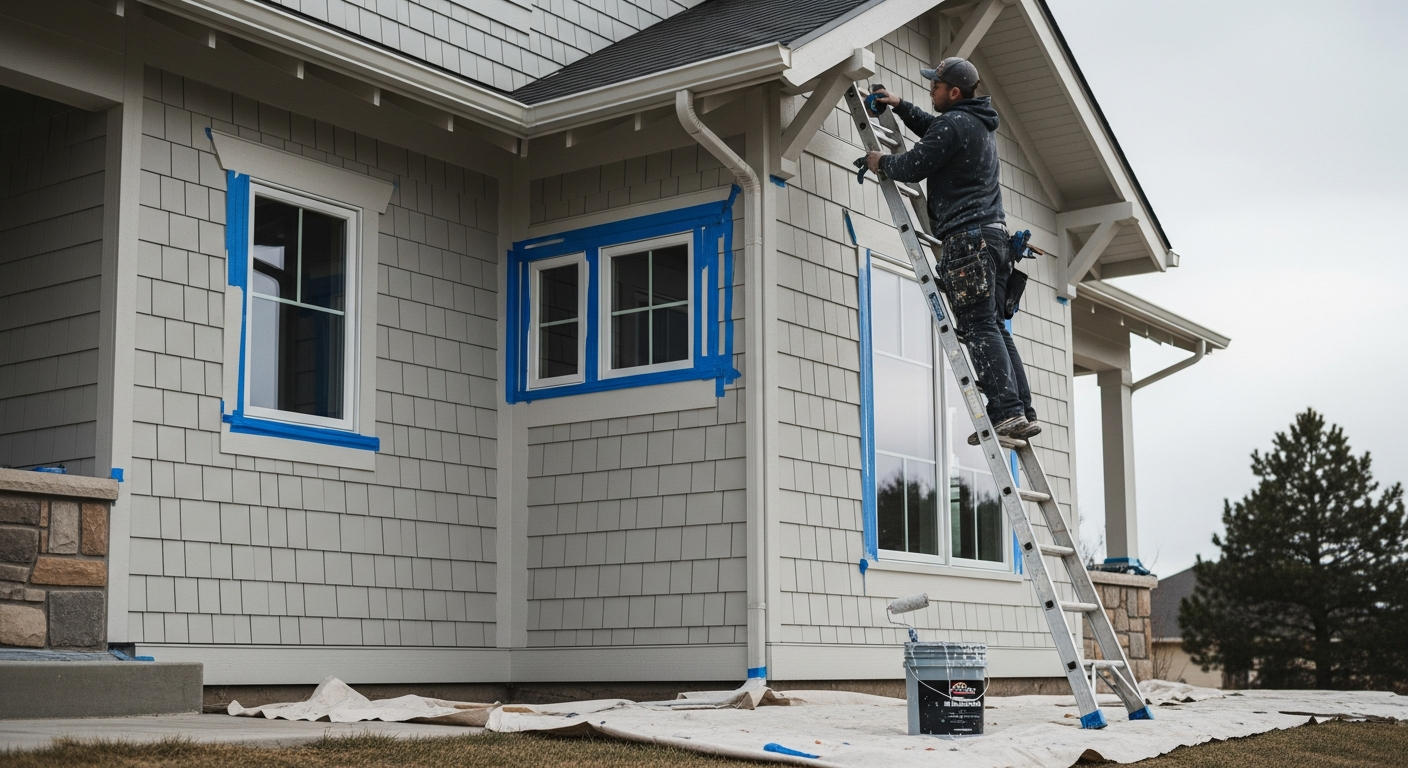
A proper Colorado exterior prep is a multi-day, multi-step process. The Painting Contractors Association (PCA) defines four levels in its Industry Standard P14, from Level 1 (basic wash and scrape) to Level 4 (near-cosmetic perfection). Most Colorado repaints on previously painted siding need work that is solidly Level 2 to Level 3.
- Inspection and moisture reading (paint cannot adhere above about 15 percent moisture)
- Pressure washing (1,200 to 1,500 psi for stucco, aluminum, soft wood; up to 2,500 to 3,000 psi for vinyl and cement) or low-pressure soft wash with biocide for delicate or chalky surfaces
- 24 to 72 hours drying time depending on temperature, sun, and humidity
- Scraping every flake of loose, peeling, or alligatored paint with a carbide scraper or 5-in-1 tool back to a sound edge
- Sanding and feathering to eliminate ridges between scraped and intact paint
- Wood rot repair: cut out punky wood, treat sound wood with epoxy consolidant, fill with two-part epoxy, or replace the board with all six sides primed before installation
- Stucco repair: wire-brush cracks, fill hairline with acrylic-latex caulk or elastomeric crack filler, V-groove and patch wider cracks with elastomeric stucco patch
- Caulk replacement at every moving joint with polyurethane sealant or premium siliconized acrylic (not painter's caulk)
- Spot priming bare wood, stains, knots, rusted nail heads, fresh patches, and chalky areas with a stain-blocking or bonding primer
- Full priming when stripping back to bare wood, dramatically changing color, or coating chalky surfaces
- Masking, plant and hardscape protection, and EPA RRP lead-safe practices on pre-1978 homes
- Two full coats at the manufacturer's recommended mil thickness
- Final dry-film inspection at PCA-defined normal viewing position (39 inches under finished lighting) for holidays, runs, sags, and missed coverage
The specific prep problems Colorado homes show
Chalking: that powdery film on south and west walls is paint binder breaking down under UV. Pressure washing alone often does not fully remove it; many Colorado contractors follow with a TSP scrub and a bonding primer rated to lock down residual chalk.
Peeling and blistering: almost always a moisture and adhesion story. Moisture comes from snow piled against siding, ice dams, daily sprinkler hits, or interior vapor pushing outward through under-insulated walls. Adhesion problems come from painting over chalk, dirt, smoke residue, or a previously failing film. The fix is to find and stop the moisture source, scrape to sound material, prime, and only then topcoat.
Failed caulk: cheap acrylic-latex caulk shrinks and cracks within 2 to 5 years in Colorado. Polyurethane sealant or premium siliconized acrylic is the right choice for moving joints; 100 percent silicone is not paintable and is the wrong choice inside a paint system.
Bare wood and sun-damaged surfaces: Colorado sun turns exposed wood gray and fibrous within weeks. UV-degraded fibers do not bond well to paint; sand back to fresh wood, prime within hours, topcoat promptly.
Hail-damaged siding: hail rarely punches through cleanly. It chips paint, fractures stucco, dents soft woods and aluminum, and crushes caulk beads. Document the damage before painting (a paint job that seals over fractured substrate compromises any roof or siding insurance claim), repair or replace fractured siding (LP SmartSide and James Hardie are the most common Front Range replacements), repair stucco cracks with elastomeric patch, then proceed.
Sprinkler damage: dry out the wood, repair rotted boards, prime with a moisture-tolerant primer, and adjust the sprinkler heads before the new paint is applied.
Wildfire smoke residue: dedicated wash with a degreasing detergent before priming.
What every paint manufacturer warranty actually says
Sherwin-Williams SuperPaint, Duration, Emerald, and Lifetime Limited warranties: shall not apply to any defect or damage resulting from improper surface preparation, structural defects, failure of a previous paint, or improper application. Excludes labor.
Benjamin Moore Aura Exterior, Regal Select, Ultra Spec Exterior: covers blistering and peeling only from properly prepared and primed surfaces. Excludes labor.
Behr Premium Plus, Ultra, Marquee, Dynasty: not valid when the product is not properly applied to a properly prepared surface. Behr reserves the right to inspect any application prior to processing your claim.
PPG Permanizer and Timeless: limited lifetime warranties conditioned on surface preparation per the label and excluding labor.
The lifetime warranty in the marketing material is a paint-only replacement warranty that requires you to prove proper prep was done. Retroactive proof is hard. A contractor's written workmanship warranty (typically 2 to 10 years in Colorado) is the practical warranty that matters.
How to read a painting bid
Compare bids on scope and prep specifics first, then on price. The biggest mistake homeowners make is comparing total dollars before comparing scope.
- Itemized prep scope (washing, scraping, sanding, caulking, priming, repairs)
- Specific paint product, line, sheen, and number of coats (Two coats Sherwin-Williams Emerald Exterior in Satin, not premium acrylic)
- Specific primer type and where it will be applied (full versus spot; oil versus acrylic versus shellac)
- Caulk brand and type (polyurethane or premium siliconized acrylic, not painter's caulk)
- Wood-rot allowance (per-board or per-foot price for repairs found during prep)
- Hail and storm damage protocol
- Lead-safe (EPA RRP) certification for pre-1978 homes
- Weather conditions for application (no application below 35 F or in direct sun on greater than 85 F surfaces)
- Workmanship warranty length and what it covers (2 years minimum; 5 to 10 signals real confidence)
- Insurance certificate (general liability and workers compensation) sent directly from the carrier
- Detailed payment schedule (small deposit, milestone payments; demanding 50 percent or more upfront is a red flag)
Lifespan by siding material in Colorado
Wood siding (cedar, redwood, pine): 4 to 7 years premium; many cedar specialists recommend stain over paint because cedar's oils and movement make paint failure almost inevitable.
Fiber cement (Hardie board): 10 to 14 years premium acrylic. James Hardie ColorPlus factory finish carries a 15-year limited warranty.
Stucco with traditional acrylic: 4 to 7 years. With elastomeric coating (10 to 20 mils thick, 200 to 360 percent elongation): 8 to 15 years. Most Colorado contractors consider elastomeric the de facto standard on stucco, not an upgrade.
Painted brick: 10 to 15 plus years with a masonry primer and a quality 100 percent acrylic or elastomeric topcoat.
Metal accents (gutters, fascia, garage doors): 5 to 10 years; rust-inhibiting primer is non-negotiable on steel; bonding primer is required on aluminum.
Decks, railings, fences (horizontal and high-use surfaces): solid stain 3 to 5 years; semi-transparent stain 2 to 3 years. Paint on decks technically lasts 5 to 10 years but is widely discouraged because trapped moisture causes peeling that requires labor-intensive scraping.
Lifespan by Colorado region (premium paint, proper prep)
Eastern plains (Limon, Sterling, Lamar): 7 to 10 years.
Denver metro (Denver, Aurora, Lakewood, Westminster, Arvada, Highlands Ranch): 7 to 10 years.
Boulder and northern Front Range (Boulder, Longmont, Fort Collins, Loveland): 6 to 9 years (chinook wind exposure).
Colorado Springs and Monument: 6 to 9 years.
Foothills (Castle Rock, Evergreen, Conifer, Sedalia): 5 to 8 years.
Mountain towns (Vail, Aspen, Breckenridge, Estes Park, Steamboat, Telluride): 5 to 7 years.
Western Slope (Grand Junction, Montrose, Durango): 7 to 10 years.