Carrier claim guide
Auto-Owners Insurance Roof Insurance Claim in Colorado
Auto-Owners Insurance is a Michigan-based mutual carrier sold exclusively through independent agents. The company has historically maintained strong financial ratings and a more conservative claims posture than some larger national carriers. Pro Shield encounters Auto-Owners on Colorado roof claims regularly. This guide covers the Auto-Owners claim flow, the agent-centric filing model, and what a homeowner should document.
Carrier snapshot
- Legal entity
- Auto-Owners Insurance Company
- Headquarters
- Lansing, Michigan
- Founded
- 1916
- NAIC code
- 18988 (Auto-Owners Insurance)
- Ownership structure
- Mutual
- Distribution model
- Independent agents
- Colorado claims phone
- Through your independent Auto-Owners agent
- Claims website
- www.auto-owners.com/customer/claims
Corporate facts above are from public sources (NAIC, A.M. Best, carrier websites). Always verify the entity, NAIC code, and claims line on your own declarations page before filing.
From storm to recoverable depreciation, in nine steps
The same nine-step path applies to every admitted Colorado homeowners carrier. What changes between carriers is the claims phone number, the field adjuster's network, and the policy-form details on your declarations page.
- 1Document
Ground-level photo sweep
Gutters, downspouts, garage door, AC fins, screens, vehicles. Adjusters look here first to corroborate roof claims.
- 2Document
Pull NOAA storm report
Save the NOAA Storm Events record for your address and date of loss. Carriers cross-reference before approving.
- 3Inspect
Free roof inspection
Colorado-licensed roofer documents slope-by-slope hail-strike count within 7 days, in writing with photos.
- 4File
Open the claim
Call the carrier claims line or file via app. Provide policy number, date of loss, NOAA event ID, and damage summary.
- 5Inspect
Adjuster meets roofer on-roof
Together they count hail strikes per 10×10 ft test square and document soft-metal damage and code upgrades.
- 6File
Receive carrier scope of loss
Itemized Xactimate pricing, ACV payment minus deductible, and recoverable depreciation hold-back.
- 7Document
Submit Xactimate supplements
Line-item supplements with photos and IRC code-section citations for missed scope (drip edge, ventilation, decking).
- 8Build
Sign C.R.S. 6-22 contract
Colorado-compliant written contract with 72-hour rescission window. No deductible rebating, ever.
- 9Build
Build, final invoice, RCV release
Permitted install per IRC R905. Final invoice releases recoverable depreciation; homeowner pays deductible to contractor.
How to file a Auto-Owners Insurance roof claim in Colorado
- Document the damage at ground level first. Photograph dents on gutters, downspouts, garage doors, AC fins, screens, and vehicles before climbing on the roof. Ground-level damage is what an adjuster looks for to corroborate roof claims.
- Pull the NOAA storm report for your address and date of loss from the NOAA Storm Events Database. Save a screenshot. Carriers cross-reference NOAA before approving hail claims.
- Schedule a free local roof inspection with a Colorado-licensed roofer within 7 days. Get the inspection report in writing with photos and a slope-by-slope hail-strike count.
- Open the claim with Auto-Owners Insurance. Call Through your independent Auto-Owners agent or file through the carrier's app or agent. Provide policy number, date of loss, NOAA event ID if available, and a brief damage summary. Get a claim number.
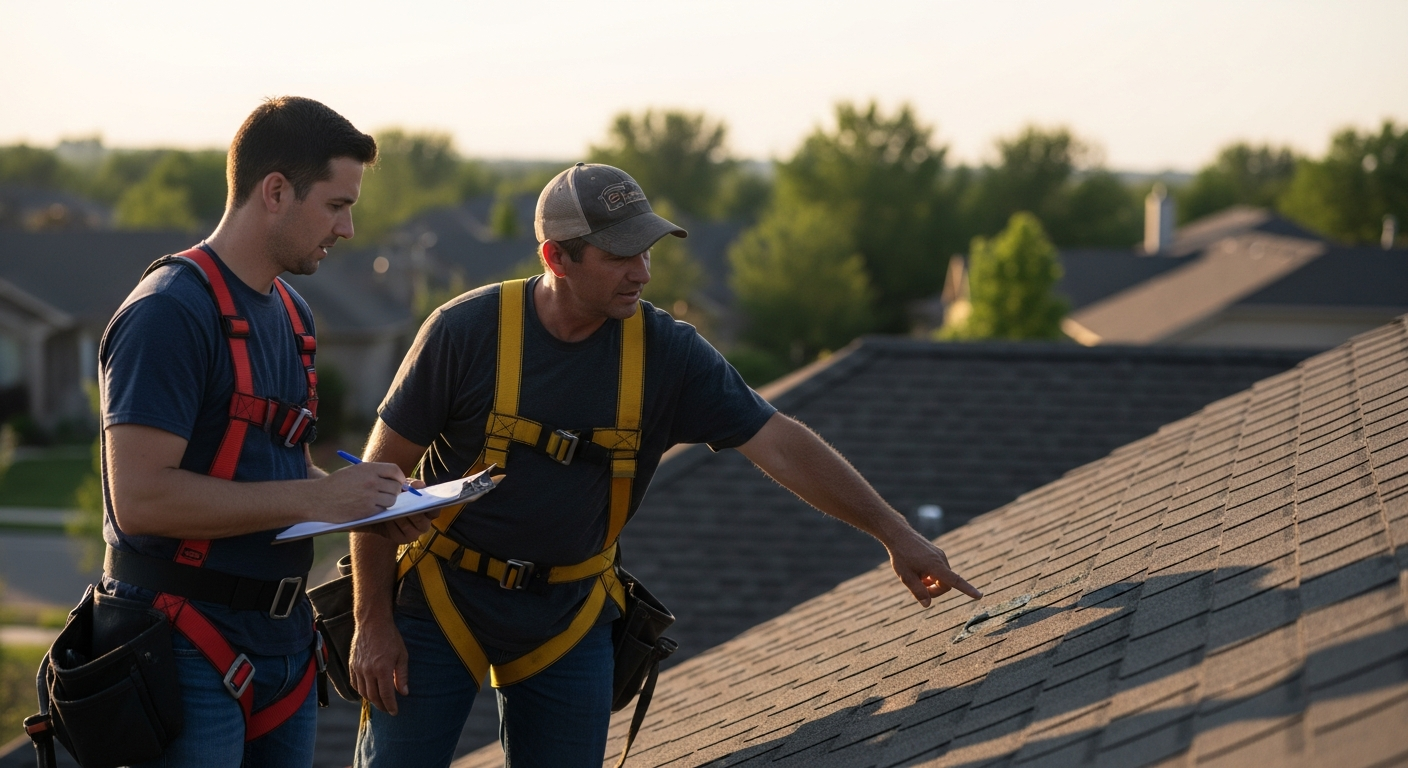
- Meet the Auto-Owners Insurance field adjuster on the roof. Ask Pro Shield to be on-site. The adjuster and roofer walk slopes together, count hail strikes per test square (typically 10×10 ft), and document soft-metal damage and code-required upgrades.
- Receive the carrier scope of loss with itemized Xactimate pricing, ACV payment less deductible, and a recoverable depreciation hold-back.
- Submit supplements for missing scope. Pro Shield writes line-item Xactimate supplements with photos and IRC code-section citations for anything the field adjuster missed (ventilation, drip edge, decking, accessories).
- Sign a Colorado-compliant roofing contract. Senate Bill 12-038 (codified at C.R.S. 6-22) requires a written contract, a 72-hour rescission window, and prohibits deductible rebates. Pro Shield's contracts comply.
- Complete the work and final-invoice the carrier. The carrier releases recoverable depreciation, less any remaining deductible, after final inspection. The homeowner pays the deductible directly to the contractor.
Colorado regulatory framework that applies to Auto-Owners Insurance
All admitted Colorado homeowners carriers, including Auto-Owners Insurance, operate under the same set of state laws and Division of Insurance bulletins. The most important for roof claims:
- HB23-1273 (Roof Claim Transparency) requires the carrier to disclose deductibles, depreciation, and any roof-specific endorsements clearly at policy issuance and renewal.
- HB23-1174 extended the non-renewal notice period in Colorado from 30 to 60 days for reasons other than nonpayment. Roof age is the most common non-renewal trigger.
- C.R.S. 6-22 (Roofing Contractors Act, SB12-038) governs Colorado roofing contracts: written contract, 72-hour right of rescission, prohibition on deductible rebates.
- C.R.S. 6-22-105 and C.R.S. 18-5-211 make rebating insurance deductibles a deceptive trade practice and insurance fraud, respectively. A roofer who offers to "cover your deductible" is offering to commit a crime.
- C.R.S. 10-2-417 reserves claim adjustment to licensed public adjusters and attorneys. Your roofing contractor is not your representative on the claim.
Auto-Owners Insurance in the Colorado market
Auto-Owners is sold in Colorado through independent agents. The carrier does not have a 24/7 direct claims call center the way larger national writers do; most claim filings flow through your independent agent first, who notifies the company.
- Auto-Owners Colorado homeowners policies are typically RCV on the dwelling, written on Auto-Owners' own proprietary forms (read your specific policy form, do not assume ISO standard language).
- Wind and hail deductibles are commonly percentage-based (1 to 5 percent of Coverage A) on Colorado policies, separate from the all-other-perils deductible.
- Auto-Owners uses Xactimate. Pro Shield's supplement workflow follows the standard line-item, photo, code-citation pattern.
- Auto-Owners has historically held A++ (Superior) financial ratings from A.M. Best, indicating strong claims-paying capacity.
Where homeowners typically run into trouble
Across all Colorado admitted carriers, the same friction points show up on roof claims year after year. Pro Shield sees them on Auto-Owners Insurance files just as we see them elsewhere. Watch for:
- Roof Payment Schedule (RPS) endorsements that depreciate roof claim payments based on roof age, even on RCV policies. Read the endorsements list on your declarations page before a loss; do not learn about an RPS for the first time after a hail event.
- Percentage-based wind and hail deductibles separate from the all-other-perils deductible. A 2 percent W/H deductible on a $500,000 dwelling is $10,000 out of pocket.
- Missed code-required upgrades in the initial scope (drip edge, ice and water shield, ventilation). These are commonly added via supplement under Ordinance or Law if your policy includes that coverage.
- Initial scope written for partial-slope repair when matching damage across multiple slopes warrants full replacement. Carriers and contractors negotiate this through supplements and, if needed, the appraisal clause.
- Door-knocking storm chasers offering to "handle everything" or "cover your deductible." Both behaviors are illegal under Colorado law. A legitimate roofer documents scope and meets the adjuster; they do not adjust the claim or rebate the deductible.
When to consider invoking the appraisal clause
Most Auto-Owners Insurance Colorado homeowners policy forms include an appraisal provision. It is a non-litigation dispute resolution mechanism: each side selects a competent independent appraiser, the two appraisers select an umpire, and the panel determines the amount of loss. Appraisal does not address coverage disputes, only scope and amount. Read your specific policy form before invoking; demand must be in writing.
Pro Shield's role on a Auto-Owners Insurance claim
Pro Shield is your roofing contractor, not your insurance representative. Under Colorado public adjuster licensing law (C.R.S. 10-2-417), only the policyholder, a licensed public adjuster, or an attorney can adjust an insurance claim in Colorado. What we do:
- Free on-roof inspection within 7 days of a storm.
- Photo documentation of hail-strike density per slope, soft-metal damage, and code-required upgrades.
- Xactimate supplement preparation with line-item photos and IRC code-section citations.
- On-site presence with the Auto-Owners Insurance field adjuster during the roof inspection.
- A Colorado-compliant written contract under C.R.S. 6-22 with a 72-hour rescission window and no deductible rebate.
- Permitting, installation per IRC R905 and ARMA/NRCA standards, and final invoicing to release recoverable depreciation.
Important disclaimer
This page is general educational information about how a Auto-Owners Insurance roof claim moves through Colorado's regulatory framework. It is not legal advice, insurance advice, or a representation about your specific policy. Auto-Owners Insurance policy forms vary by state, program tier, and effective date. Read your own declarations page and policy. For coverage questions, consult Auto-Owners Insurance directly, your licensed insurance agent, the Colorado Division of Insurance, or an attorney. Pro Shield is not affiliated with, endorsed by, or sponsored by Auto-Owners Insurance.